
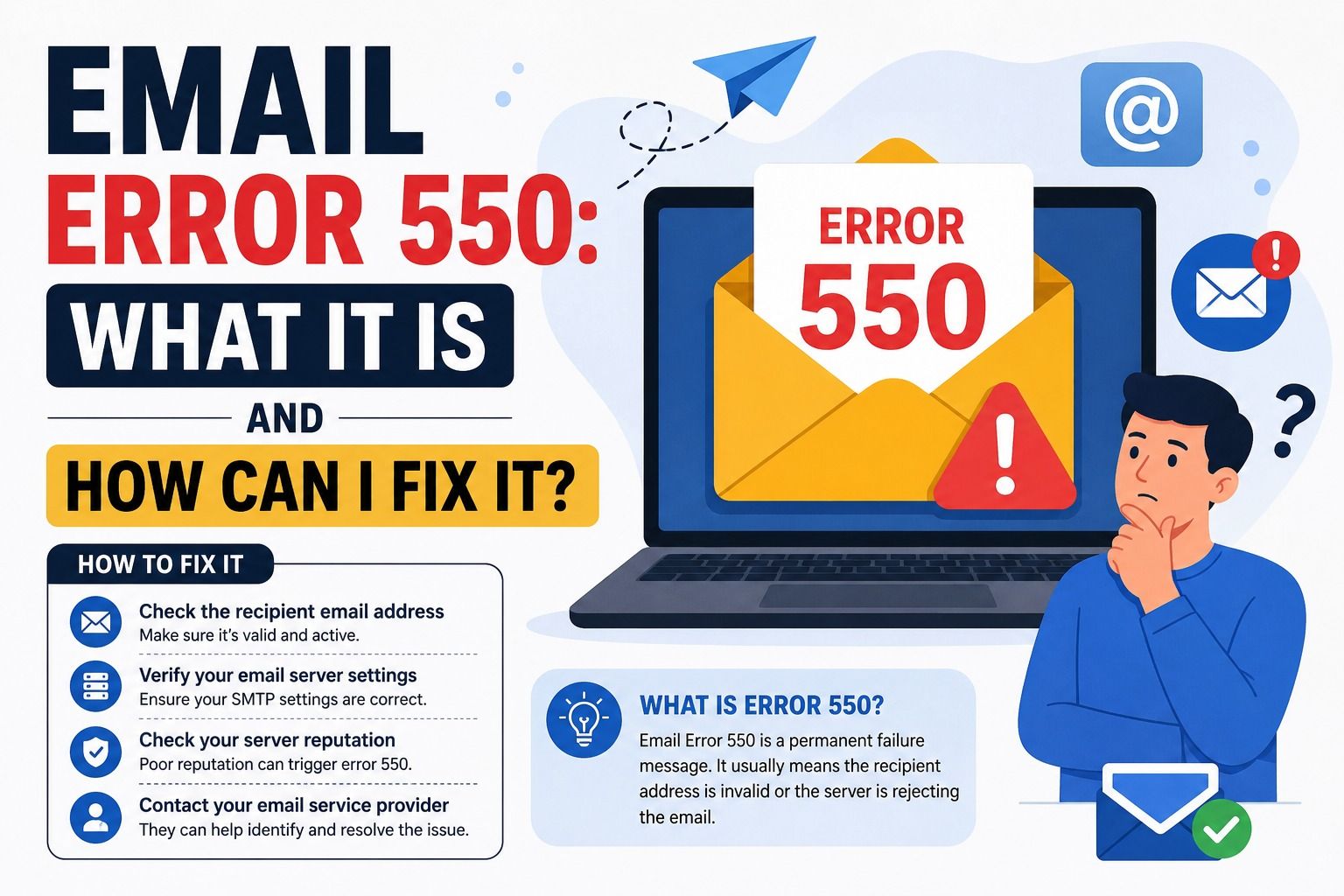
An Email Error 550 message, in its most basic form, signifies that the recipient's email hosting server rejected the email you sent and sent it back to you.
The message is understandable and can help in identifying the problem's origin, even though it may seem obscure to the inexperienced eye.
How did the email error 550 start?
A set of uniform guidelines for sending and receiving email is known as SMTP. As a result, it is sometimes referred to as the SMTP error code 550. Email error 550 can occasionally be brought on by a recipient-side problem.
The following are a few examples of email error 550 causes:
- The mail server of the receiver has blocked your email because it was compromised.
- The recipient's email address is invalid.
- The recipient's email address is now suspended or inaccessible.
- The recipient's hosting server is momentarily unavailable.
- Your domain name is blocked or is wrong.
- A firewall or filtering function on your internet gateway may have mistakenly classified and blocked your email as spam.
- Your email is wrongly categorised as spam by the recipient's mail server.
- Your email programme is using a unique IP address.
- The recipient's mail server does not recognise your email address.
- The most typical abbreviation for email mistakes is 550.
Address Rejected Email Error 550 in 5.1.0
Your emails will not be delivered to the recipient, according to this error message. Most likely, this is as a result of the recipient's email address being blacklisted.
Email Error 550 5.1.1
This error message suggests that the recipient's email address you submitted is incorrect or does not exist in the destination domain. This could happen as a result of server configuration issues or mistakes in the recipient's email address.
Access Denied Due To Policy Email Error
It demonstrates that because email security software restricts outgoing emails, attackers are prevented from figuring out email addresses.
5.4.1 Error 550 in Email
The recipient's server apparently does not accept emails received from your domain, according to this error notice. A DNS configuration issue is a common source of this problem.
Error Code 550: Invalid Message Size in Email
When a file in an email is larger than the email's allowed size limit, this error occurs.
Access Denied Email Error 550, 5.7.1
This error message indicates that the email was rejected because of faulty recipient setup or recipient security policies.
Error 550: Administrative Prohibition
There are several possible interpretations for this error message:
- The domain of your SMTP server is immediately blacklisted.
- The addressee is making use of a domain that is currently blacklisted.
- The IP address of the SMTP server is dynamic.
- 550 E-mail Error Relay Unauthorized
- This means that the server of the recipient does not allow the email to be sent from the server you are using.
Quarantined email or 550 Error Quarantined Recipient
This means that your email was not delivered because it was tagged as spam. You will see the same error message if your email address is blacklisted.
550 SPF mistake
To assess whether or not a sender is legitimate, a mail server will examine a domain's Sender Policy Framework (SPF) record. If you try to send email from an IP address that is not registered with SPF, you will see this error message.
550 Reverse DNS Error
This suggests that either there isn't a reverse DNS record for the IP address of the mail server or that the email's sending domain has inconsistent records.
Email problem 550: There is no user with that name on this domain or the receiver is unknown.
The recipient's mail server cannot find the recipient's mail account, according to this error notice. Typos in email addresses can lead to this.
Error 550 in emails: Unknown host
The SMTP server transmits this message if the hostname supplied in the email address is unrecognised.
The 550 email error spam risk is high?
Check email addresses for grammatical issues.
A typographical error in an email address can result in Email Error 550. Make sure there are no additional spaces or typos in the email address you supplied. Furthermore, the recipient might have given you the wrong email address. Confirm with them as well.
Make sure your email is filled out completely and that the address is entered correctly. Emails without any content will sometimes be rejected by mail servers.
Check to see whether the email address is not on a blacklist.
Most of your emails will fail to deliver to their intended recipients and bounce if your email IP address is blacklisted in a DNS blacklist.
If your email IP address appears on this list, one of the following conditions applies:
- A spam script is being uploaded to the webmail application as a result of a vulnerability being exploited.
- Your email account has been compromised, and someone is sending spam from it.
- Additionally, different blacklist databases identify email IP addresses using various criteria. Finding a database for the aim of evaluating your possibilities is therefore wise.
- To see if your email IP address has been blocked, check this page.
- You can start the process of removing your email IP address from the blacklist once you've found the blacklist database.
- Try sending an email after a while.
- It is possible that the recipient's server is momentarily down for a number of causes. You can either wait a few minutes or hours before trying again, or you can let the receiver know that the server might be down and ask for an alternative email address.
You can also modify the port number for your outgoing mail.
Because spammers regularly use port 25 to deliver spam, there is a potential that servers will block your email if your email application uses that port for outgoing mail. A different option is to switch your port to 26, 465, 587, or 2525.
Before traffic may flow, you must confirm the port change if you're using a firewall.
Make sure IP filtering is enabled.
You can set your SMTP server to only allow users from a given IP address range. If this is the case, you will be unable to send messages from other locations. By getting in touch with the administrator of the mail server, this can be easily fixed.
Enabled SMTP authentication
The majority of email apps automatically configure SMTP authentication. Incorrect configuration of the application will prevent you from sending emails. SMTP can fortunately be manually configured.
If you're using Mozilla Thunderbird, take these actions.
From the top menu, choose Tools, followed by Settings.
From the Settings menu, choose Outgoing Server (SMTP), then click Edit.
Next to the SMTP server you want to set up, click Edit.
Check or retype your password and username.
Choose OK.
If you're using Outlook, take these steps.
Account Settings can be found under the File Tab.
On the Email Tab, double-check and choose your email address. Then, click the Change icon to the right of it. Open Internet Email Settings at this time.
Click on it to see the Outgoing Server tab.
Now choose the circle-box that says "Use similar parameters as my incoming mail server" and tick the box that says "My outgoing server (SMTP) requires authentication."
Once you've selected OK, click Finish.
Please be aware that depending on the email application you are using, there may be different procedures to enable SMTP authentication.
Look into the SSL procedure.
As was already said, the majority of email clients configure SMTP using an auto-discovery option. Several SSL combinations will be available when configuring SMTP manually, including:
- None
- STARTTLS
- SSL/TLS
You must first confirm the SMTP server's SSL configuration during manual setup before configuring the email client.
Phone your Internet service provider.
It is advised that you get in touch with your Internet Service Provider for support if none of the aforementioned fixes work to address your problem. It's possible that your email is being blocked by your ISP's email filtering system.
How can a 550 error be fixed?
incoming email inspection
If your email account has been hacked and is being used to send spam, email error 550 may appear. All incoming emails are automatically scanned by anti-spam programmes. To verify that your account is not being used improperly, install anti-spam solutions that also scan outgoing emails.
Virus-check uploaded files
If an attacker manages to get into your account, they will utilise it to distribute malicious files and spam messages. Set malware scanners up to automatically check each file uploaded in order to prevent this.
Block direct SMTP server outgoing connections.
Direct connections to distant SMTP servers may be attempted by spam scripts. By preventing these connections, emails can be sent only through email servers, which is simpler to monitor and respond to when necessary.
Set a maximum for the amount of emails you can send each hour.
An email user should generally limit their email sending to no more than 50 per hour. Therefore, depending on your usage, it is advised that the maximum number of emails sent per hour be 50 or less. Thus, the amount of harm a spammer can cause is much diminished.
Use a firewall while using web applications.
Your system can be shielded from attackers using web application vulnerabilities by firewalls. Additionally, this will safeguard your account from spammers.
Different password
It is advised that you regularly update your passwords. Make sure your passwords don't include any personal information, such as your name, age, or birthdate. Combine letters, symbols, and numbers to make it more robust.
Conclusion
As you can see, email error 550 may or may not be simple to fix depending on the cause. Email failures can happen even if your recipient's inbox is overflowing. Additionally, it is wise to utilise email security software and regularly update your passwords given the large number of hackers trying to attack email application flaws.